Join World's Fastest Growing B2B Network
Join World's Fastest Growing B2B Network



Rice is one of the most important agricultural products in global trade. It feeds more than half of the world's population and plays a major role in food security. For many countries, rice is not only a staple food but also an important export commodity. This makes the global rice industry highly strategic for governments, traders, distributors, and food manufacturers.
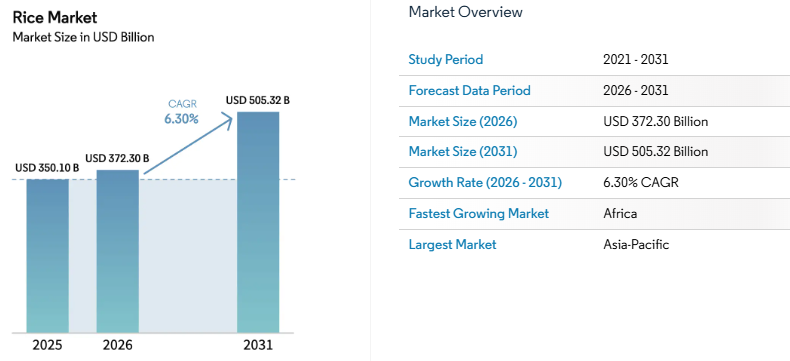
Talking about rice market stats, the rice market size was valued at 350 billion USD in 2025. By the end of 2026, it is expected to become a 372 billion USD industry. By 2031, the market is projected to reach the value of 505 billion USD with a CAGR of 6.30%.
There are many nations that control a large share of the world’s rice market, and they include India, China, Thailand, Vietnam, and Pakistan. The other thing worth mentioning about the global rice trade is that other countries in Africa, the Middle East, and Southeast Asia still rely on importing rice from these countries.
Rice traders have to stay updated on what is happening in the rice market to benefit from current trends. This is important since any policy change or changes in climatic conditions can influence the cost of rice.
Only a handful of countries dominate global rice production. The major producers of rice in the world are China and India. The reason why these two countries dominate global rice production is due to the large size of agriculture practiced in the regions and the large local consumption demand.
The rice market share globally is concentrated in Asia. Among them, China is the largest producer of rice, while India is the leading exporter. Other major producers are Bangladesh, Indonesia, Vietnam, Thailand, and Pakistan.
In recent years, other emerging producers are Cambodia and Myanmar. Improvements in their agricultural techniques and development of their export infrastructure have enabled these countries to gain market share in the global market.
Leadership in this sector is increasingly shifting to those nations that focus on increasing their production and enhancing export capabilities. Nations that have effective production systems and trade-friendly policies are increasingly taking up larger shares in global trade.
There are a few major exporters who play a significant role in influencing rice prices worldwide. India continues to be the major exporter and provides around 40% of global rice exports. High levels of production and affordable pricing make India maintain its dominant position in the industry.
Other major exporters include Thailand, Vietnam, and Pakistan. The above-listed countries have managed to establish effective export channels and develop buyer networks in Africa, the Middle East, and Asia. They play a dominant role in the global rice trade.
Many leading exporters are characterized by cost efficiency and larger-scale production. India and Vietnam have created effective logistics and supply chain systems, enabling them to offer affordable prices to international buyers. It becomes crucial for buyers in price-sensitive regions.
Quality is an important aspect of global trade. India and Pakistan are known for producing premium quality basmati rice, and Thailand for jasmine rice.
Efficient logistics networks help facilitate exports. Nations that have modern ports and infrastructure and sign agreements for trade purposes have an edge when moving goods. Such advantages increase dependability and make them favorable destinations for foreign buyers searching for reliable partners.
During the past ten years, there has been intensive investment in technologies and infrastructure by exporters. This has greatly improved their performance.
There is a growing worldwide demand for imported rice as populations increase and there is an increased need for food intake. Several nations are importing due to insufficient production from homegrown agriculture.
Major rice-importing countries include the Philippines, Indonesia, Nigeria, Saudi Arabia, Iran, China, and several countries of West Africa. Such markets offer great opportunities for exporters and international traders.
Urbanization has led to increased rice consumption in various developing nations. With migration into towns, people have a preference for processed rice products.
The issue of imports of rice per country is also increasingly gaining importance among those firms that are looking for potential sources of demand. The demand from the continent of Africa is rapidly rising due to population increase and changes in dietary preferences.
Countries like Nigeria, in particular, are increasingly becoming prominent players in the international rice trade. Moreover, the rising demand for premium varieties of rice is seen in the Middle East region and Southeast Asia. Exporters have plenty of new opportunities due to this factor.
There are several primary trade routes in the global rice market that link countries with surplus supply to those with high demand. Knowledge of these routes is helpful when planning pricing, supplies, and sourcing. There are several major trade routes within the rice trading business.
The first important thing is that Asia is the core of the global export market for rice. India, Thailand, Vietnam, and Pakistan are countries exporting rice in large quantities to buyers in Africa, the Middle East, and Asia. Plenty of African countries buy rice because of the low level of domestic production relative to rising demand.
Rice trade statistics reveal that West Africa still plays a crucial role in being one of the biggest destinations for shipments of rice from Asia. Nigeria, Senegal, and the Ivory Coast keep increasing their imports due to high demand and population growth.
Another major destination is the Middle East. Saudi Arabia, the United Arab Emirates, and Iran purchase considerable quantities of premium rice from India and Pakistan. Basmati rice, in particular, continues to be highly demanded in the region.
Intra-Asian trade also keeps developing. The Philippines, Malaysia, and Indonesia purchase rice regularly from their neighbors. Central Asia and East Africa can be considered new regions of interest due to the development of food security policies there.
Rice imports play a vital role in feeding people in Africa. Companies from India, Thailand, and Vietnam have been making strides to build stronger market positions in Africa through long-term supply contracts and government procurement programs. Companies that understand the demand dynamics of the market will find themselves in a good position.
The Middle East remains one of the main consumers of high-quality rice. Cultural preference and a lack of sufficient production in the region result in increased demand for imports. Companies like India and Pakistan benefit from the high reputation for the production of high-quality basmati rice.
Asian trade is expanding as a result of shifting consumption patterns and supply gaps. Independent nations prefer to import from regions due to the shorter distance of transport and reduced transport costs.
The structure of the global rice market has been significantly transformed during the past decade. Certain countries have increased their exports and become more influential on the market, whereas others have lost their shares because of production problems and changing policies.
India has increased its market share in the rice trade owing to the high production rate and affordable prices of exports. The country remains the leader of the market and dominates international trade as before.
Vietnam has also managed to improve its position with the help of the development of agricultural technologies, good quality control, and export infrastructure. Cambodia has become an emerging exporter and attracts more international customers.
Some leading exporters have faced some problems because of the increased cost of production, shortage of workforce, and weather problems. This has worsened their competitiveness in some markets.
Some new trends in consumer behavior have also affected the situation in the rice market. The demand for high-quality and premium rice varieties is continuously increasing. Exporters who concentrate on quality and brand names become more influential.
Several factors affect the global rice trade. These factors influence production costs, export volumes, and purchasing decisions. Businesses must understand these drivers to reduce risks and improve planning.
The Asia-Pacific region is still the major producer of rice in the world. Rice is produced in China, India, Thailand, Vietnam, and Pakistan, and exported around the world. It has the advantages of excellent farm experience, favorable conditions for growing, and well-developed trading networks. A lot of international buyers count on deliveries of their goods from Asia all year round.
Africa is one of the quickest-growing importing markets. Rapid population increase, urbanization, and changing food preferences lead to increased demands. Some African countries are still lacking in production, and this provides long-term exporting prospects. The growth of importing countries in Africa will help in the further development of global trade for the next ten years.
The Middle East is completely dependent on imported rice because of a lack of agricultural land. Such countries as Saudi Arabia, Iran, and the United Arab Emirates import rice annually in large amounts. Consumers still appreciate expensive varieties. This market is still important for exporters from India and Pakistan.
Europe and North America mainly concentrate on exporting premium and specialty rice products. There is an increasing demand for organic rice and healthy food in general.
Tradewheel.com is a trusted online B2B platform where you can source and sell rice and other agricultural products. Buyers and suppliers meet in this marketplace to connect, communicate, and close profitable deals. Unlike many platforms that depend on AI, Tradewheel.com provides real human support to make trading easier, more effective, and reliable.
Political and economic events may significantly influence the world rice trade. Countries often implement certain policies to ensure their food security during times of uncertainty. Their actions may have an immediate effect on the price level and supply of rice.
Export restrictions still play a vital role in influencing the market. In case large producers put some limitations on their exports, global consumers will have to pay higher prices and compete with each other for obtaining rice. In the light of these mishaps businesses need to diversify their supplies.
Various food security programs will also influence the trade policies of companies. Many countries will focus on local production and creating reserves in order to avoid dependency on imported products.
Problems with deliveries due to geopolitical factors, logistics, or economic sanctions will influence the shipping process. Companies that use the global approach should be prepared for such challenges.
Trade agreements also influence market access. Positive agreements will decrease tariffs and facilitate the trade process. Strong international relationships will allow the exporters to open new markets and develop further. Buyers' geography becomes more significant as companies seek reliable producers from different regions.
There are multiple growth opportunities in the global rice industry for all types of businesses, including exporters, importers, distributors, and food companies. If you understand the trends going on in the rice industry, you will be able to excel in this business.
Market development and expansion are definitely the best way to go right now. There is increased interest in African, Middle Eastern, and some Asian regions. Businesses that are able to form strong local connections will be able to benefit greatly from market development.
Private label products have become very popular in recent years. You can offer custom packaging, branding, and product specifications. It is possible to get higher profits through such an approach and increase profit margins.
Diversification of supply is another opportunity that should not be overlooked. The customers are actively looking for alternatives. It means that new suppliers and even countries have great chances to grow their businesses.
Online platforms have changed the process of procurement significantly. Procurement processes have become more transparent, faster, and efficient. It is possible to manage inventories much more easily now due to technology.
Rice export market growth will offer lots of opportunities to those who invest in quality logistics and customer services.
The future of the international rice market is promising. The demand is set to rise amid population growth and increased food consumption in the economies of the world. Businesses need to adapt to new market circumstances and buyer preferences.
According to the Organization for Economic Co-operation and Development and the Food and Agriculture Organization, the demand for global rice is projected to keep rising until 2030.
The rice market share in the future may shift as new producers boost their output and become more competitive in exports. Those countries that invest in technological infrastructure and sustainability will probably gain more market share.
Africa is likely to be one of the main growth regions for imports. Some Asian exporting nations are likely to increase their investment in these markets.
Sustainability will be a key factor. Buyers will become more interested in working with suppliers that practice sustainable farming. The criteria of ESG (Environmental, Social, and Governance) will have increasing importance in their decision-making.
Farmers' adoption of new technologies will generate more output and help to overcome the problems caused by the climate. The latest rice trade statistics suggest that global demand will remain strong through the end of the decade and continue creating opportunities across the supply chain.
Rice remains one of the most important agricultural commodities in global trade. Its market is expanding and will continue to grow as demand increases with population growth. In this blog, we have discussed rice market share by country, latest trends, and import and export opportunities businesses can explore globally. Tradewheel.com is a reliable online B2B marketplace through which you can buy and sell rice in bulk at wholesale prices.
Serving millions of Buyers & Sellers around the world
Join Free 30-Apr-2026
Rice is one of the most consumed foods in the world. The global trade of this product is growing very fast. The major trading regions all depend on the import of rice to meet the demand. Because of this, the wholesale rice suppliers and exporters are
11-Feb-2026
Introduction Did you know that rice is one of the most important staple foods, providing 50% of the whole daily caloric intake for more than half of the world’s population? Rice is considered a major source of energy, with consumption varying

One moment please





 Browse Through Millions of High-Quality Products.